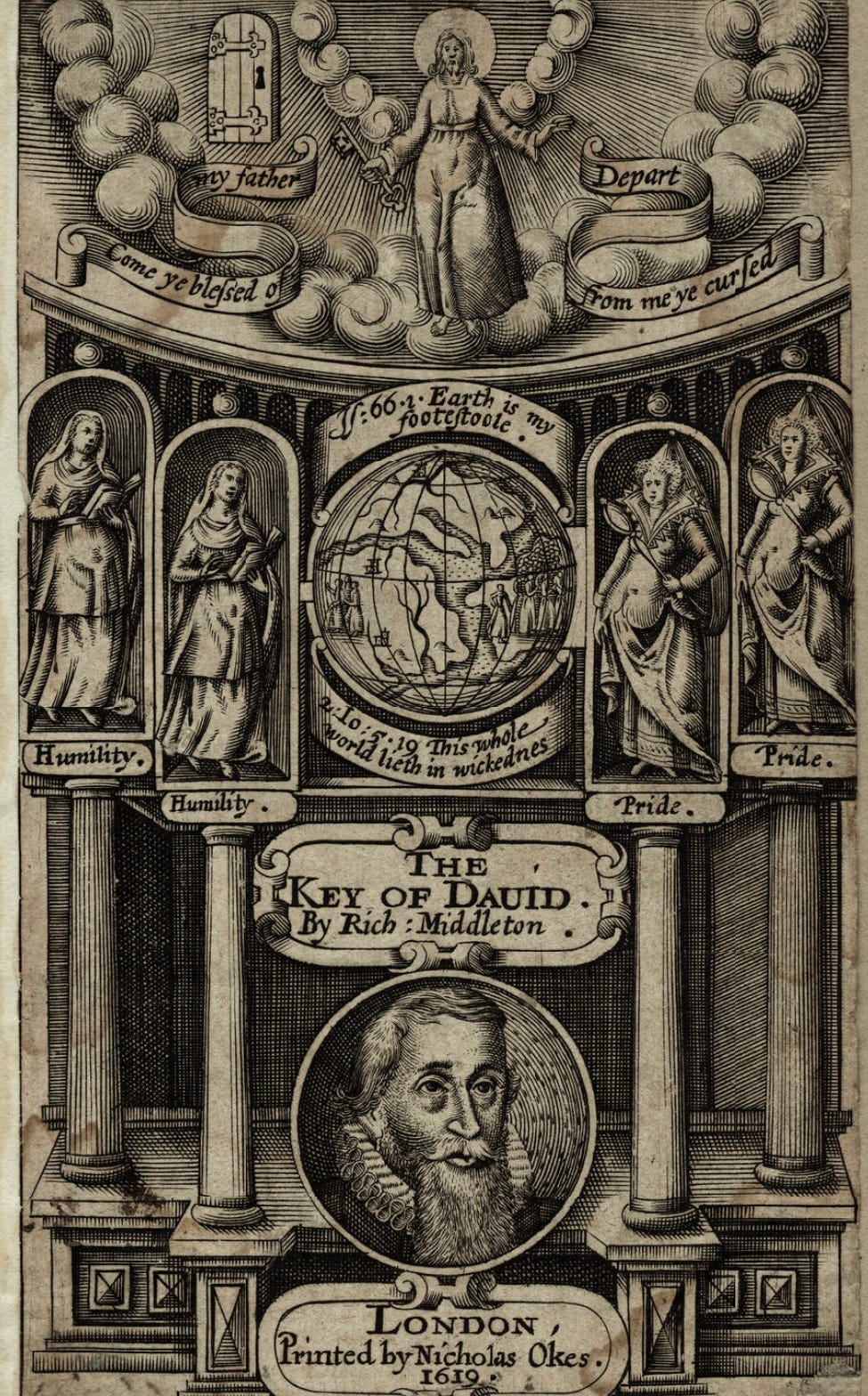
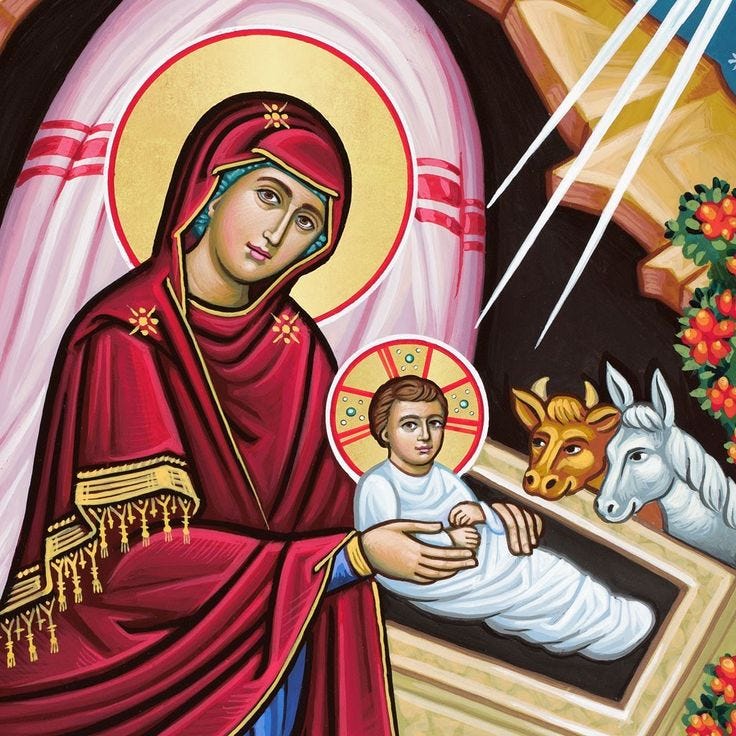
O Clavis David

Come, O Key of David

Friends,

Today’s O Antiphon is below—in its Latin, English, and adapted forms. Subscribers can keep reading below the image for a short reflection and another response poem by the brilliant Fr. Malcolm Guite. I hope these brief moments of reading and reflection help you capture the heart of Advent in this busy final week before Christmas.

Latin Text
O Clavis David, et sceptrum domus Israel;
qui aperis, et nemo claudit;
claudis, et nemo aperit:
veni, et educ vinctum de domo carceris,
sedentem in tenebris, et umbra mortis.

English Translation
O Key of David and sceptre of the House of Israel;
you open and no one can shut;
you shut and no one can open:
Come and lead the prisoners from the prison house,
those who dwell in darkness and the shadow of death

O Come, O Come, Emmanuel Adaptation
O come, O Key of David, come
and open wide our heavenly home.
Make safe for us the heavenward road
and bar the way to death's abode.

Give a gift subscription

A Poetic Response, by Fr. Malcolm Guite

The ancient O Clavis David verse describes Jesus as the Key that locks and unlocks life's ultimate mysteries; opening to us the way of life, while closing to us the way of death.

In today's poem by Fr. Guite, that same theme is also highlighted. But Guite also helpfully reminds us that there is only one key for our lock. Without that specific key, we have no hope.

We know our problem, and want a solution. And so we cry out for the advent of our Key.

O Clavis / O Key
Even in the darkness where I sit
And huddle in the midst of misery
I can remember freedom, but forget
That every lock must answer to a key,

That each dark clasp, sharp and intricate, Must find a counter-clasp to meet its guard, Particular, exact and intimate, The clutch and catch that meshes with its ward.

I cry out for the key I threw away That turned and over turned with certain touch And with the lovely lifting of a latch Opened my darkness to the light of day. O come again, come quickly, set me free Cut to the quick to fit, the master key.

O Radix Jesse

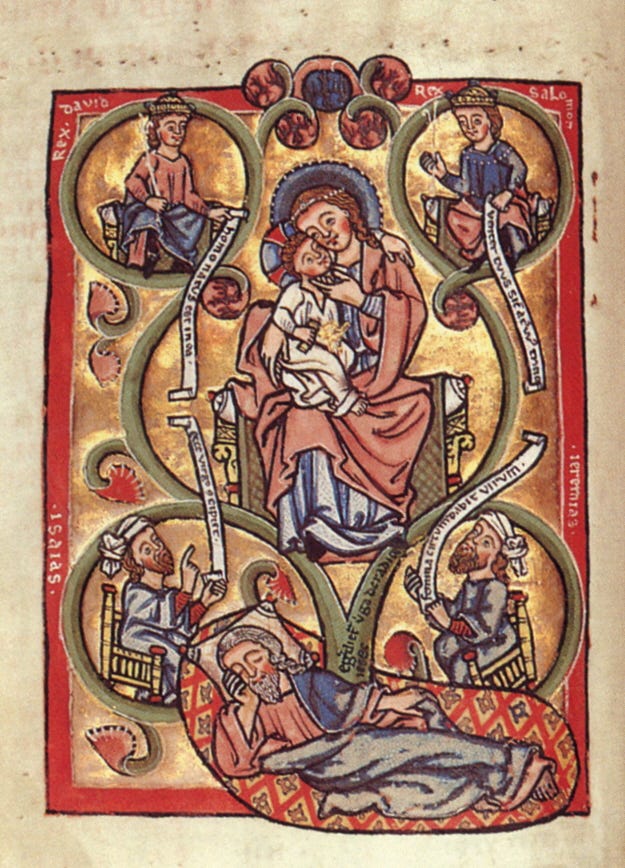
Come, O Root of Jesse

Friends,

Today’s O Antiphon is below—in its Latin, English, and adapted forms. Subscribers can keep reading below the image for a short reflection and another response poem by the brilliant Fr. Malcolm Guite. I hope these brief moments of reading and reflection help you capture the heart of Advent in this busy final week before Christmas.

O Radix Jesse

Latin Text
O Radix Jesse, qui stas in signum populorum,
super quem continebunt reges os suum,
quem Gentes deprecabuntur:
veni ad liberandum nos, jam noli tardare.

English Translation O Root of Jesse, standing as a sign among the peoples; before you kings will shut their mouths, to you the nations will make their prayer: Come and deliver us, and delay no longer

O Come, O Come, Emmanuel Adaptation O come, O Branch of Jesse’s stem, unto your own and rescue them! From depths of hell your people save, and give them victory o’er the grave.

A Poetic Response, by Fr. Malcolm Guite

Though it reads as a response to the virtual world we have all increasingly lived in to various degrees since March 2020, today's poem by Fr. Guite was written well before the pandemic. It draws to mind our rootedness in salvation history, and presents Jesus to us as a return to the way we were created to live.

O Radix / O Root
All of us sprung from one deep-hidden seed,
Rose from a root invisible to all.

We knew the virtues once of every weed, But, severed from the roots of ritual, We surf the surface of a wide-screen world And find no virtue in the virtual.

We shrivel on the edges of a wood Whose heart we once inhabited in love, Now we have need of you, forgotten Root The stock and stem of every living thing Whom once we worshiped in the sacred grove, For now is winter, now is withering Unless we let you root us deep within, Under the ground of being, graft us in.

O Adonai

Come, O Lord

Friends,

Today’s O Antiphon is below—in its Latin, English, and adapted forms. Subscribers can keep reading below the image for a short reflection and another response poem by the brilliant Fr. Malcolm Guite. I hope these brief moments of reading and reflection help you capture the heart of Advent in this busy final week before Christmas.

O Adonai

Latin Text
O Adonai, et Dux domus Israel,
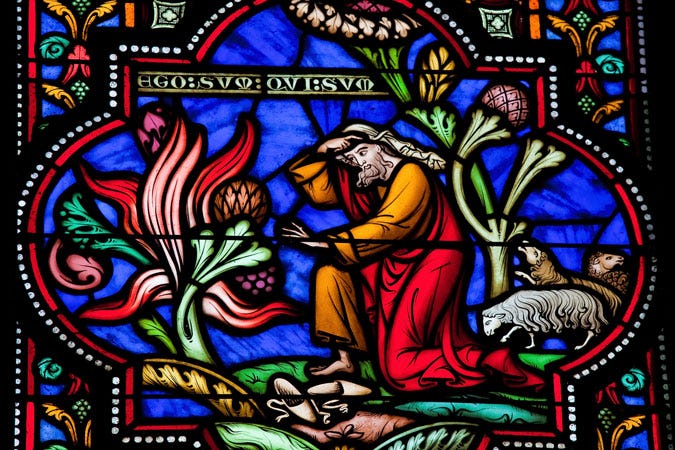
qui Moysi in igne flammae rubi apparuisti,
et ei in Sina legem dedisti:
veni ad redimendum nos in brachio extento

English Translation O Adonai, and leader of the House of Israel, who appeared to Moses in the fire of the burning bush and gave him the law on Sinai: Come and redeem us with an outstretched arm

O Come, O Come, Emmanuel Adaptation O come, O come, Great Lord of might, who to your tribes on Sinai’s height in ancient times did give the law in cloud and majesty and awe.

A Poetic Response, by Fr. Malcolm Guite

Today's poem by Fr. Malcolm Guite plays on the most important name God gives himself throughout the Scriptures: Yahweh, "I Am." The four letters YHWH—referred to as the Tetragramaton—spell out the Divine Name of God.

This name is considered so sacred that both ancient and modern Hebrews have refused to write or speak it aloud. In its place, scattered all throughout the Old Testament, is the word Adonai, most often translated as "Lord."*

This poem captures the reality that the God whose name is so Holy it cannot even be said aloud has met us face to face in the form of a child.

O Adonai / O Lord
Unsayable, you chose to speak one tongue,
Unseeable, you gave yourself away,
The Adonai, the Tetragramaton
Grew by a wayside in the light of day.

O you who dared to be a tribal God, To own a language, people and a place, Who chose to be exploited and betrayed, If so you might be met with face to face, Come to us here, who would not find you there, Who chose to know the skin and not the pith, Who heard no more than thunder in the air, Who marked the mere events and not the myth. Touch the bare branches of our unbelief And blaze again like fire in every leaf.

O Sapientia

Come, O Wisdom

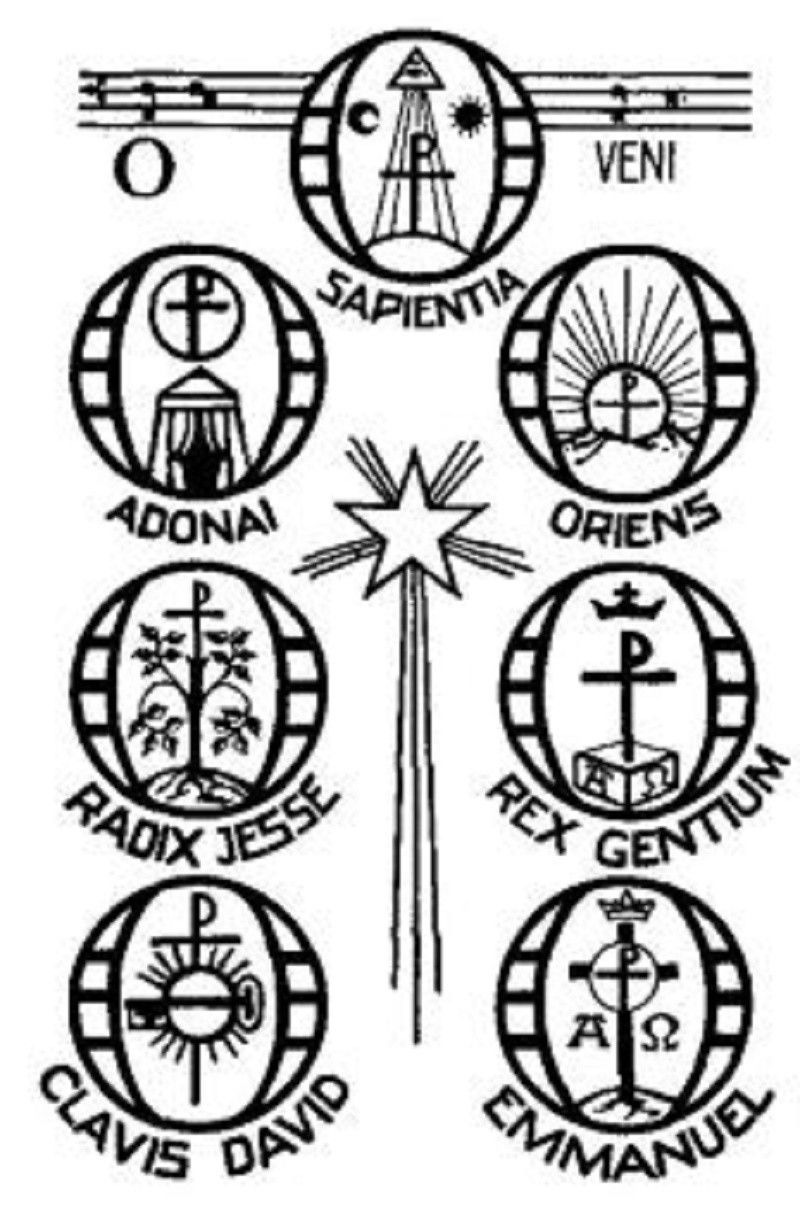
Christians throughout the ages have spent the final week of Advent singing, praying, and reflecting upon the seven great O Antiphons. These ancient verses have been captured in the lyrics of the great hymn O Come, O Come Emmanuel, but existed far before the hymn itself.

These O Antiphons describe to us more fully who it is that we anticipate during Advent.

Yes, “God with Us” is coming afresh on Christmas this year; but Jesus is always far more than we imagine him to be. Each of the seven O Antiphons capture just a bit more of who Jesus was and is, and what he offers to bring when he comes to us.

December 18: O Sapientia (Wisdom)
December 19: O Adonai (Lord)
December 20: O Radix Jesse (Root of Jesse)
December 21: O Clavis David (Key of David)
December 22: O Oriens (Dayspring)
December 23: O Rex Gentium (King of the Nations)
December 24: O Emmanuel (With Us is God)

But here is where it gets fascinating.

These seven antiphons, when reading backwards from Christmas Eve, form an accrostic: ero cras, which is latin for "Tomorrow, I will come."

So today we begin this seven day journey with our first Antiphon: O Sapientia. Below is the text of the ancient verse, the text of the modern hymn, and a poetic response to this verse by Malcolm Guite.

O Sapientia

Latin Text

O Sapientia, quae ex ore Altissimi prodiisti,

attingens a fine usque ad finem,

fortiter suaviterque disponens omnia:

veni ad docendum nos viam prudentiae.

English Translation

O Wisdom, coming forth from the mouth of the Most High,

reaching from one end to the other mightily,

and sweetly ordering all things:

Come and teach us the way of prudence.

O Come, O Come, Emmanuel Adaptation

O come, O Wisdom from on high,

who ordered all things mightily;

to us the path of knowledge show

and teach us in its ways to go.

A Poetic Response, by Fr. Malcolm Guite

O Sapientia / O Wisdom

I cannot think unless I have been thought,

Nor can I speak unless I have been spoken.

I cannot teach except as I am taught,

Or break the bread except as I am broken.

O Mind behind the mind through which I seek,

O Light within the light by which I see,

O Word beneath the words with which I speak,

O founding, unfound Wisdom, finding me,

O sounding Song whose depth is sounding me,

O Memory of time, reminding me,

My Ground of Being, always grounding me,

My Maker’s Bounding Line, defining me,

Come, hidden Wisdom, come with all you bring,

Come to me now, disguised as everything.

The final week of Advent means it is time for the seven O Antiphons. I find these to be helpful antidotes to the business of the final week before Christmas. You can subscribe to Rhythms of Habit today to receive daily reflections on these antiphons between now and Christmas.

Fourth Week of Advent: Salvation

Jesus is Emmanuel

We all already follow a wide variety of calendars. Sometimes those calendars conflict with one another. (I am serving this morning at Church while the World Cup final is being played, for example. Two of my favorite calendars are not playing well together…)

Of all the Church seasons, it may be Advent that is most often at odds with our other cultural calendars. While we celebrate Advent, a season of reflection, penitence, and anticipation, our other calendars tend to increasingly fill up with business and festivities.

I think this is most true during the final week of Advent, as the cultural Christmas season reaches the crescendo of its intensity just as the Church season is asking us to persevere in learning to wait, pause, anticipate, and reflect.

So as you finalize your hosting and travel plans, and cross the last few items off of your shopping list, all while squeezing in a holiday party or two, allow the final week of Advent to do its job my taking just a moment each day to pause, pray, read, and reflect.

To help towards that end, Rhythms of Habit will be sending out short reflections on the seven O Antiphons each day for the next week. These antiphons have traditionally been sung along with the Morning and Evening Prayer Psalms in the final week leading up to Christmas. They are known most commonly today as the hymn O Come, O Come, Emmanuel.

The first of those emails will be sent out this evening to subscribers. Be sure to subscribe now, or consider gifting a subscription to a friend, if you would like these daily emails between now and Christmas.

Give a gift subscription

For now, read below for a few notes about the theme of this final week of Advent.

Fourth Week of Advent: Salvation

So far throughout Advent we have heard themes of Judgment, Repentance, and Rejoicing. In the final week of this season, our attention is now turned to the Salvation offered in Jesus, God-with-us. A few notes about this theme are below, as well as the Gospel reading and Collect for this Sunday.

  • The previous weeks of Advent have instilled in us a deep understanding that we stand in need of salvation. This final week prepares us to recognize Jesus as that salvation.

  • There are two names given to Jesus in this week’s Gospel passage, and St. Matthew makes sure that his readers understand what each of them mean. Jesus, God saves, is also Emmanuel, God with us. Salvation and relationship go hand in hand.

  • This theme is also highlighted by a refrain found in Psalm 80, appointed for today:

Restore us, O Lord God of hosts; show the light of your countenance, and we shall be saved.

  • Turn your face to us, and we shall be saved. The final week of Advent reminds us that in the Incarnation of our Lord, God has taken on a face for the purpose of our salvation.

  • Our task is to prepare to receive Emmanuel when he arrives. Jesus’ first Advent was in a manger; the collect this week asks God to help us prepare our own hearts to be more hospitable than Bethlehem.

Gospel Reading: Matthew 1:18-25

Now the birth of Jesus the Messiah took place in this way. When his mother Mary had been engaged to Joseph, but before they lived together, she was found to be with child from the Holy Spirit. Her husband Joseph, being a righteous man and unwilling to expose her to public disgrace, planned to dismiss her quietly. But just when he had resolved to do this, an angel of the Lord appeared to him in a dream and said, “Joseph, son of David, do not be afraid to take Mary as your wife, for the child conceived in her is from the Holy Spirit. She will bear a son, and you are to name him Jesus, for he will save his people from their sins.” All this took place to fulfill what had been spoken by the Lord through the prophet:

“Look, the virgin shall conceive and bear a son,
and they shall name him Emmanuel,”

which means, “God is with us.” When Joseph awoke from sleep, he did as the angel of the Lord commanded him; he took her as his wife, but had no marital relations with her until she had borne a son; and he named him Jesus.

Collect

Purify our conscience, Almighty God, by your daily visitation, that your Son Jesus Christ, at his coming, may find in us a mansion prepared for himself; who lives and reigns with you, in the unity of the Holy Spirit, one God, now and for ever. Amen.
A lesson in governance as I navigate changing traffic signal timing for a light near our school:

The people I interact with in the city office are very helpful, from the Director to the phone operators. The processes they are tied to are mind-numbinly bad.

Third Week of Advent (Rejoice!)

The One With the Pink Candle

Liturgical colors—those featured in various Holy Days and Holy Seasons—do more than remind us of what season we are in. (Though that is always helpful.) In a future post we’ll explore the ins and outs of these colors—what they signify and what they do to us.

But I mention colors this week because you have likely noticed that Advent candles are not uniform in color: most of the candles are purple (the color of the season), and there is sometimes a white or gold candle in the center to be lit on Christmas Day. But there is also a seemingly misplaced pink candle that is to be lit on the Third Sunday of Advent.

Continue reading to discover why the candle is pink (hint: it isn’t actually pink), what to focus on during this third week of advent, and even a bonus micro-lesson on Latin verb conjugation!

Rejoice

The color for the Third Sunday of Advent is not technically pink, but rather rose. Rose is the liturgical color for rejoicing. The only other time rose is used liturgically throughout the year is on Laetare Sunday in the season of Lent. In both cases, rose is a call to rejoice even while living within a season of penitence.

Advent is a penitential season; a time to reflect on our need for a savior and in doing so, to anticipate the advent of that savior. As we have mentioned previously, it is even common practice to fast in some way throughout the season.

As much as we should reflect, repent, and anticipate, there is also reason to rejoice throughout Advent. The coming of Jesus is, after all, good news.

In this spirit, the Third Sunday of Advent is traditionally known as Gaudete Sunday. Gaudete is latin for rejoice, but it is worth noting that it is actually the second-person plural present active imperative form of the word gaudeo (rejoice).

In other words: gaudete is a command (imperative) for all of us (second-person plural) to rejoice this week (present active).

The readings and prayers for this week of Advent are still calling us to reflect, repent, and anticipate, but there are signs of rejoicing throughout. In the Gospel reading the blind see, the dead are raised, the poor have good news brought to them, and in our Collect we ask God to come among us to do the same.

At this point, we are halfway through the season of Advent.

While Gaudete Sunday is more than a pick-me-up in the middle of the season, it is not less than that. In practice, it would be liturgically appropriate—even encouraged—to find a way to rejoice this week. Don’t spoil the anticipation entirely by abandoning your whole fast, or raiding the Christmas tree and stockings early. But perhaps you can intentionally modify your fast—skip one element and feast instead—or otherwise mark this week as one of rejoicing that Jesus is coming among us.

Gospel Reading

Matthew 11:2-11

When John heard in prison what the Messiah was doing, he sent word by his disciples and said to him, “Are you the one who is to come, or are we to wait for another?” Jesus answered them, “Go and tell John what you hear and see: the blind receive their sight, the lame walk, the lepers are cleansed, the deaf hear, the dead are raised, and the poor have good news brought to them. And blessed is anyone who takes no offense at me.”

As they went away, Jesus began to speak to the crowds about John: “What did you go out into the wilderness to look at? A reed shaken by the wind? What then did you go out to see? Someone dressed in soft robes? Look, those who wear soft robes are in royal palaces. What then did you go out to see? A prophet? Yes, I tell you, and more than a prophet. This is the one about whom it is written,

‘See, I am sending my messenger ahead of you,
who will prepare your way before you.’

“Truly I tell you, among those born of women no one has arisen greater than John the Baptist; yet the least in the kingdom of heaven is greater than he.”

Collect of the Week

Stir up your power, O Lord, and with great might come among us; and, because we are sorely hindered by our sins, let your bountiful grace and mercy speedily help and deliver us; through Jesus Christ our Lord, to whom, with you and the Holy Spirit, be honor and glory, now and for ever. Amen.

A full few days of putting up lights, a family hike, USA soccer, basketball, Bob Goff, and work on the playhouse.

Second Week of Advent

Advent as a call to joy through repentance.

There are some things that are very real, and yet very invisible.

We often see the result of these things, but the thing itself remains unseen.

Wind may be a good example. Wind is very real—nobody would argue with that. But it is also very invisible. There are no wind particles that make up “wind.” We can see trees or dust or debris being moved by the wind, but we cannot see wind itself. 

Gravity is another good example. As a force, it is not something we can see. But we do see, and experience, its effects. 

This is a created universe.

And as such, this universe operates according to the will of its creator. 

Much of the work of Science—especially in the fields of Chemistry and Physics—is to simply discover the invisible rules that govern the physical universe. And when humans grow in their understanding of the invisible physical rules that govern the universe, it leads to more flourishing. 

We can design airplanes that don’t subvert the force of gravity, but rather harness it, along with other invisible forces, to allow us to travel great distances with relative ease.

This is a created universe.

And as such, this universe operates according to the will of its creator. And this will of its creator most often plays out through invisible realities—invisible rules that hold the physical world together and ensure it continues to exist.

This is as true in the moral realm as it is in the physical realm.

The universe operates—physically and morally—according to the will of the creator. 

We are capable of ignoring the invisible realities of the physical realm. And we are capable of ignoring invisible realities of the moral realm.

Sin is the word the Scriptures give us to describe the reality that as creatures, we are capable of choosing to work against the moral grain of the universe.

Human suffering, evil, discontentment. These are the result of humans willfully operating against the grain of the universe. 

Our creation was not a morally neutral event.

We were created to live in accordance with the designs and desires of the one in whose image we were made.

When we ignore the laws of gravity, there are consequences. For us, and for those around us. 

And when we ignore the moral laws of the universe, there are consequences. For us, and for those around us.

You do not always do what you ought to do, because you are not always who you ought to be.

This is the message of the prophets of the Old Testament. It is the message of John the Baptist—the last of the Old Testament prophets that just happens to come to us at the beginning of the New. 

It is even the first sermon preached by Jesus.

Before you can say the all-important “yes” to the ways of God, you have to come to a point that you are tired of the ways of the world. Before you attempt to align with the moral grain of the universe, you have to recognize the specific ways you are fighting against it. 

A “yes” to God is first a “no” to the world.

And the word we have for this experience is repentance.

Repent. For the Kingdom of Heaven is at hand.

John the Baptist, by William Wolff

The Second Week of Advent: Repent

On the second week of Advent, we ask God for a gift. A gift that we cannot give ourselves. One that requires God to act on our behalf.

We ask God this week for grace to heed the warnings of the Prophets, and to forsake our sins.

Repentance is at least three things.

  • It is a recognition that there is an invisible moral grain to the universe. It is an apocalyptic moment, and epiphany. A seeing of things that can’t be unseen. Of course there is a moral law. Of course it works just like our physical laws. It is not a list of rules; it is a force that holds the world together. It leads to flourishing and thriving, to whole human relationships. With our selves, with one another, and with God. Repentance is a recognition that God has created the world to work a certain way.

  • But repentance is also an acknowledgement that we fail to live out the moral law in our own lives. It isn’t a pointing of fingers at those around us or above us or below us. It is owning up to the reality that we fall short. We intentionally and unintentionally work against the grain of the moral law. And we want that to change. Repentance is a forsaking of our sin, a desire to align our lives with the ways of God.

  • Finally, and perhaps most crucially, repentance is knowing that we have no power within ourselves to help ourselves. The first time you see the moral law for what it is, and have a desire to change your ways, you might think that you alone are capable of making things right. Of just trying harder. Of pulling yourself together. 

    But for most of us this isn’t our first rodeo. We’ve been down the path of trying to fix ourselves on our own. It doesn’t simply not work: it most often makes things worse.

    Repentance is a gift from God—one that he never tires of giving. But it is first and foremost just that: a gift. Unearned favor from our creator. 

We can choose to continue down the path of doing things our way, of working against the grain. Or we can heed the warning of the prophets and repent. We can turn to God for salvation, and for the grace to increasingly align ourselves with His ways.

What is at stake in all of this is nothing less than our capacity for ultimate Joy.

We will stand before our creator one day. 

Those who seek the grace of repentance here and now will be prepared to greet that day with Joy.

So this is the message of the second Sunday of Advent:

Repent, and learn to live a life the runs with the moral grain of the universe now, so that when you meet it face to face on That Day, you will be able to greet Him with Joy.

Gospel Reading: Matthew 3:1-12

In those days John the Baptist appeared in the wilderness of Judea, proclaiming, “Repent, for the kingdom of heaven has come near.” This is the one of whom the prophet Isaiah spoke when he said,

“The voice of one crying out in the wilderness:
‘Prepare the way of the Lord,
make his paths straight.’”

Now John wore clothing of camel’s hair with a leather belt around his waist, and his food was locusts and wild honey. Then the people of Jerusalem and all Judea were going out to him, and all the region along the Jordan, and they were baptized by him in the river Jordan, confessing their sins.

But when he saw many Pharisees and Sadducees coming for baptism, he said to them, “You brood of vipers! Who warned you to flee from the wrath to come? Bear fruit worthy of repentance. Do not presume to say to yourselves, ‘We have Abraham as our ancestor’; for I tell you, God is able from these stones to raise up children to Abraham. Even now the ax is lying at the root of the trees; every tree therefore that does not bear good fruit is cut down and thrown into the fire.

“I baptize you with water for repentance, but one who is more powerful than I is coming after me; I am not worthy to carry his sandals. He will baptize you with the Holy Spirit and fire. His winnowing fork is in his hand, and he will clear his threshing floor and will gather his wheat into the granary; but the chaff he will burn with unquenchable fire.”

Collect for the Second Sunday of Advent

Merciful God, who sent your messengers the prophets to preach repentance and prepare the way for our salvation: Give us grace to heed their warnings and forsake our sins, that we may greet with joy the coming of Jesus Christ our Redeemer; who lives and reigns with you and the Holy Spirit, one God, now and for ever. Amen.