Why celebrate Saints?

The church calendar trains us to honor most those people most worthy of being honored.

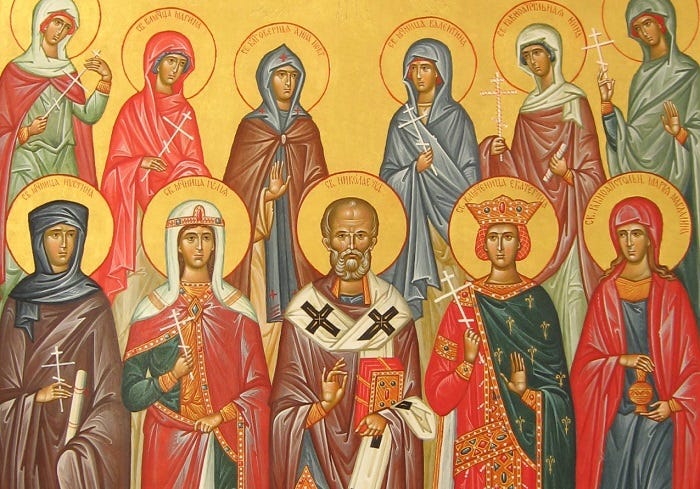
Different Christian Traditions have various official and unofficial ways of canonizing or otherwise recognizing the faithful departed whose lives of holiness have made a profound impact on the Body of Christ. Some of these Saints even have Feast Days on the Church Calendar in recognition of their life and work. Some of these Feast Days have remained culturally relevant long after the religious significance of the holy day has been lost. (Looking at you, St. Patrick!)

If the Church Calendar’s primary purpose is to help us become more like Jesus, why are there so many Saint Days and commemorations of people other than Jesus sprinkled throughout the Church Year?

As is often the case, St. Paul and C.S. Lewis both have something helpful to say about this great question. And what they have to share might just reveal why honoring Saints from Christian history is perhaps a more important practice today than it has ever been.

The only real sadness, the only real failure, the only great tragedy in life, is to not become a saint.

Léon Bloy

The first step to living a holy life worthy of the title “Saint” is a recognition of how impossible that task truly is. It is also hard to imagine a Saint that does not spend serious time each day in prayer and the reading of Scripture. But I think there is a third significant step to becoming a Saint, one that St. Paul teaches us in his epistle to the Corinthians: imitate people who imitate Christ.

Follow me as I follow Christ.

1 Corinthians 1:11

Yes, Jesus is the ultimate human example. The Church Calendar is built entirely around commemorating his life and saving work. We do become more like him by adopting his overall pattern of life year after year.

But there are degrees of holiness, and sometimes we can learn quite a bit by spending time with folks who are further along on the same path that we are. By following someone with more experience in the long obedience in the same direction that is the Christian life, we don’t just become more like them; we become more like Jesus, too.

But there is more.

I am convinced we need Saints Days today more than ever.

International online celebrities are rampant, in both the secular and religious worlds. We are invited to follow and honor countless people in a given day.

And without noticing it, we begin to follow and honor people without considering the degree to which we should. This matters because humans always—slowly but surely—become like the people they honor most.

Or, as C.S. Lewis once put it:

Where men are forbidden to honor a king, they honor millionaires, athletes, or film stars instead; even famous prostitutes or gangsters. For spiritual nature, like bodily nature, will be served; deny it food and it will gobble poison.

C.S. Lewis, Equality

You will become like those whom you honor most.

The church calendar trains us to honor most those people most worthy of being honored. In return, we might just find ourselves becoming like them.

A change I made to my work email last week has proven quite fruitful:

Emails that I am copied on now skip the inbox and go directly to a CC folder. I check that folder once or twice a day. With this one change, my work inbox has has gone from hundreds to dozens of daily emails.

Tottenham’s “win or tie even when it’s ugly” approach has finally caught up to them. I would not want to be sitting near Antonio Conte on the flight back to England…

I still think they wind up on top of their Champion’s League group, but this is a much needed wake up call.

One of the benefits of following the Church calendar is the nearly constant reminders that it brings. Holy Cross Day (September 14) is a great example of this: squarely on the other side of the calendar from Good Friday, we are reminded again of the centrality of the Cross.

Holy Cross Day

September 14

Calendars, by their very nature, are reminders of important things we already know but that we risk forgetting in the business of life. One of the benefits of adopting the practice of following the Church calendar is the nearly constant reminders that come along with it.

Holy Cross Day, celebrated on September 14, is a perfect example of this.

On a day that falls squarely on the other side of the calendar from Good Friday, we are reminded again of the centrality of the Cross.

The Triune God revealed throughout the Scriptures is many things: Creator, Judge, Healer, Comforter, source of all Wisdom and Mercy. But at the center of this story is a crucified Savior, who took on the sins of the world.

Charlie Jackson | Flickr

Christians have done many things throughout the ages to ensure their lives are—at times quite literally—marked by the cross. Tertullian was known for making the sign of the cross on just about every physical object he interacted with. It was his way of ensuring that everything he did—from writing a letter to getting dressed—was done in light of the Gospel. In many churches, the congregation makes three small crosses using their thumb—one on their forehead, one on their lips, and one more over their heart—whenever one of the Gospels is read aloud. This is a physical reminder that the Good New of God in Christ is to be always on our mind, on our lips, and in our hearts.

When Christians began to build their own churches, the vast majority of them were designed with a cruciform layout. This is not the most practical of designs, but it did ensure that the people of God were cross-shaped when gathered together for worship. (This practice is still very much alive in many corners of the church today.)

There is also a rather impressive history of variants in the cross design itself, with each rendition signifying an important aspect of the Cross of Christ.

So, on this Holy Cross Day, how can you be shaped by the cross?

Habit to Adopt: Find somewhere to display a cross, perhaps where you need to see it most. It can be as simple as a sticky note on your dashboard, or an ornate crucifix in your study. Allow this visual reminder to orient your thoughts back to the forgiveness extended to you by God himself. Sometimes this is what we need if we have any hope of extending the same to others.

Historical Note: The origin of celebrating this Holy Day—which was originally called the Feast of the Exaltation of the Cross—dates back to the dedication of the Church of the Holy Sepulchre (Jerusalem) in AD335 by Emperor Constantine. Within a few decades of this dedication, this feast had also became associated with a growing number of stories that St. Helena (Constantine’s mother) had discovered the original cross at the Sepulchre. A 4th century Christian text is the first to associate the date of September 14 with both the discovery of that cross and the celebration of this feast.

To my earliest paid subscribers: thank you! I am greatly encouraged to by your support.

Share Rhythms of Habit

Give a gift subscription

O earth, how like to heav’n, if not preferred

The opening line of Satan’s soliloquy in Book IX of Paradise Lost.

Introducing Rhythms of Habit - a newsletter about approaching the church calendar as an apprenticeship in holiness

I am thrilled to introduce Rhythms of Habit, a newsletter about approaching the Church Calendar as an apprenticeship in Holiness.

In addition to (hopefully) being a helpful and informative newsletter, this project is also a means of finalizing the draft of my next book, called Rhythms of Habit: The Church Calendar as an Apprenticeship in Holiness.

If you are already sold, head on over to Substack to join as a free or paid subscriber. If you need to hear more, read on!

A little more about the Rhythms of Habit project:

As we live out the Christian Year together, three types of posts will be published:

  • Introductory: these posts explain how following the calendar is good for your growth as a Christian. The first three of these are free to everyone, and help give a foundation for why you might want to start following the Church Calendar.
  • About the Church Calendar: these posts share the history of the church calendar, some things that are helpful to know, and help answer common questions. Why do we celebrate saints? What is Epiphany really about? How did these seasons develop? What is a Triduum?
  • Holy Day / Holy Season Reflections: these posts are the real core of the newsletter. As we encounter Holy Days and Holy Seasons throughout the year, you will be given habits to consider adopting that are rooted in who or what is being celebrated by that day or season.

If you are new here or new to the Church Calendar, you may want to explore the free introductory posts. Think of these as the introductory foundation of the newsletter.

More of these Introductory posts, along with many About the Church Calendar posts will be sent throughout the year to subscribers.

But here is the real core of the newsletter: Holy Day and Holy Season reflections.

As we progress through the Church Calendar year after year, reflections on major and minor Holy Days will be shared. Yes, you will learn more about the calendar itself. But more importantly you will be given daily or seasonal practices and habits to adopt, in hopes that these habits will help you grow in Christ. You can find a free preview of these sort of reflections here: Feast of St. Joseph.

Why Subscribe?

Free subscribers have access to some of these posts throughout the Church Year. If you like what you are reading, consider becoming a paid subscriber to make sure you receive all new reflections as they are published, and gain access to reading all old reflections, too.

The first Holy Day reflection will be on September 14th, when we celebrate Holy Cross Day. Subscribe by then to make sure you don’t miss a post!

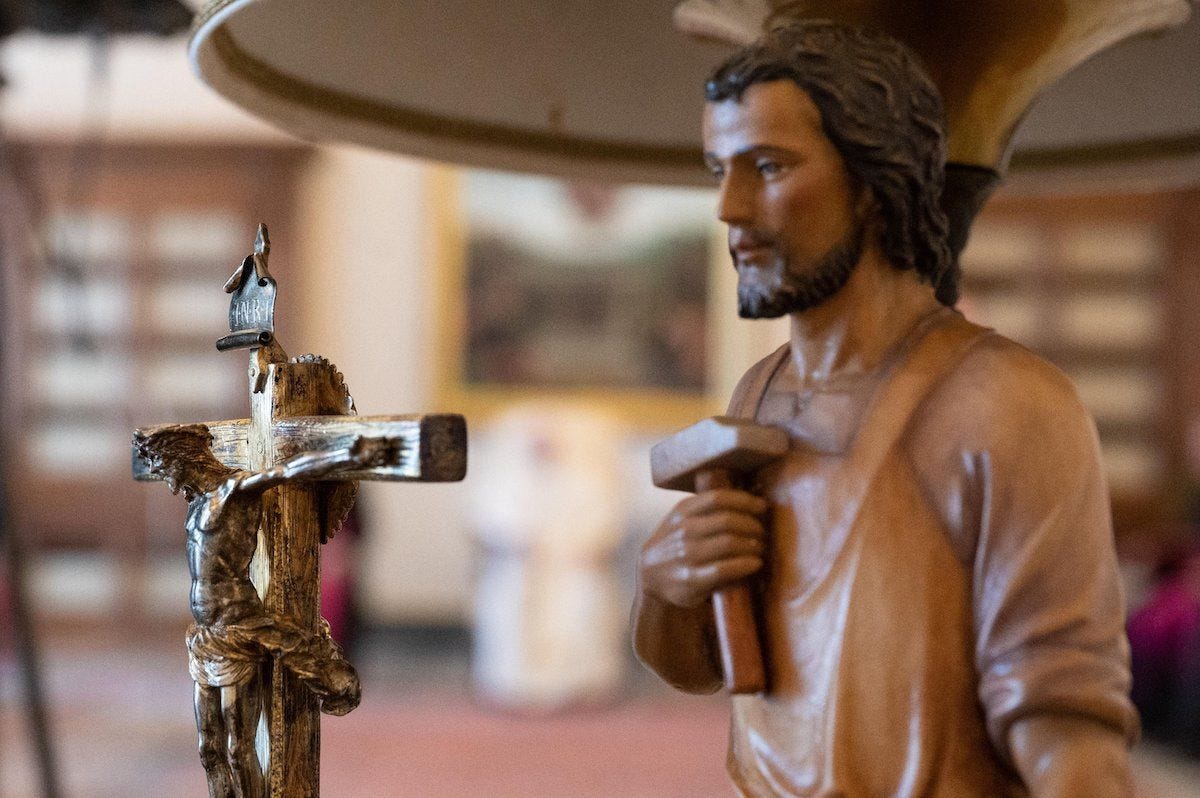
St. Joseph, March 19

St. Joseph is a model of quiet, often thankless work that paves the way for Jesus to be known and loved.

George Weigel describes the history of God’s dealing with humanity as “an extraordinary story involving some utterly ordinary people.”

An adopted son of a slave with a speech impediment is used by God to accomplish the greatest saving act of the Old Testament. The King of Persia’s bartender is used by God to restore the city of Jerusalem after its destruction at the hand of Babylon. A group of ragtag fishermen and rabbinic school dropouts are used by God to establish the Christian Church, and are told by Jesus that they will spend the rest of their lives doing “greater things than these.”

And right in the middle of this extraordinary story lies Joseph of Bethlehem. An ordinarily quiet dad who works hard, forsakes his legal freedom to dismiss Mary, and instead bears the brunt of communal shame so his new wife doesn’t have to. (Not to mention that his first experience in parenting involved raising the Son of God.)

I am the proud owner of multiple pairs of socks that feature Saints from the Scriptures and Christian history. The side of each sock bears the image of the Saint, and on the bottom of each foot is a famous quote from their life and work.

As a (sometimes) quiet dad myself, I naturally own a pair of Saint Joseph socks.

And printed on the bottom of each foot is the following quote:

“                       ."

- St. Joseph

Joseph has no recorded words in the Christian Scriptures. He is visited by an angel. He leads his family on several journeys: first to Bethlehem for the less-than-glamorous birth of Jesus, then to Egypt, this time as refugees. And after several quiet years in Egypt, Joseph leads his family once more to settle down in the podunk town of Nazareth. And from this point on, we know very little about how Joseph spent the rest of his days. 

We see in St. Joseph a model of quiet, often thankless work that paves the way for Jesus to be known and loved.

Habit to Adopt: At some point throughout our week, we all have quiet, thankless work to do. We are washing the dishes, or filing papers, or taking out the trash. The next time you catch yourself doing this routine work, turn off the TV, take out the headphones, or otherwise limit distractions. Allow the quiet—and the noise of the work itself—to remind you to pray that God will use your otherwise menial task to somehow make Jesus known and loved.

Rhythms of Habit is a reader-supported publication. To receive new posts and support my work, consider becoming a free or paid subscriber.

Intro 3: Why We Need a Calendar

You are what you schedule

Imagine today is January 2nd, and a friend bumps into you in the produce aisle of the local grocery store. After picking up the groceries that fell out of your hand you make eye contact and say “Happy New Year” followed by an awkward smile. Your “Happy New Year” is interpreted appropriately by your friend as “Seeing as we are only two days into the new year according to the Gregorian Calendar, I wish you well in the 364 days ahead of us.”

So far no surprises.

Rhythms of Habit is a reader-supported publication. To receive new posts and support my work, consider becoming a free or paid subscriber.

Now imagine that it is August 12th, and you have just returned to school as a teacher. You are greeted by a parent of one of your students as you are walking out of an orientation meeting. After asking about your summer, and waiting the appropriate amount of time to show just the right level of interest in your answer, they look you in the eye and say “Blessings on your new year.” You and this parent both interpret the words “Blessings on your new year” to mean “I wish you well in the school year ahead of us, which begins tomorrow and ends in the middle of May.” Neither of you assume that the words “Blessings on your New Year” shared in August refer to the Gregorian New Year celebrated on January 1st. It is clear that the School Calendar, and not the Gregorian Calendar, are in mind here.

For a final time, imagine with me that it is the end of a particularly disappointing season for your favorite sports team. Slowly making your way out of the stadium, a face-painted stranger bumps into you and says, “there’s always next year.”

Nobody interprets this to mean that as soon as 2017 becomes 2018 your team will be granted immediate success. We know that, in this case, next year simply means next season, whether that season begins in the current Gregorian year or not.

As my grandfather would say, “I hope you are sniffing what I am stepping in.”

It turns out that when we say “Happy New Year” we may actually be referring to a wide range of calendars, each with their own “new year” celebrations. Whether we do so intentionally or not, we all follow a variety of calendars, whether they are national, cultural, personal, lunar, solar, marital, or recreational in nature.

This is the first premise of this chapter: We already follow a variety of calendars.

So far this is merely an observation of the way things are. What comes next begins to reveal why it matters that we pay close attention to the calendars we follow.

You Are What You Schedule

Every Spring I conduct an experiment with a group of students. I did this once with a group of teachers and, to many of the students’s surprise, the results were nearly identical.

I ask the students to respond to what I am about to say with a simple facial reaction. They are to smile if their response to my words is generally positive, and frown if their response to them is generally negative.

Then I ask them to give me a blank facial expression before I utter those words every student longs to hear: “Summer break.”

As you can imagine, the room was full of smiles.

Everyone in the room, whether teacher or student, has spent a good amount of their life following the school calendar. By following this calendar year and year, they have actually learned to love summer.

To an accountant, or an engineer, or a doctor, “summer” is simply the time of year that you go to work when it is hot outside. To those of us in the world of education—even for those of us who work through the summer—there is a sense of freedom, flexibility, and bliss when summer arrives.

The School Calendar has taught us what to love.

We have already agreed that we follow a variety of calendars. But there is more at stake here. Calendars actually have the power to shape what we love, to influence our desires. Whether we are paying attention to them or not, the various calendars we follow are shaping our desires.

This should be at least a little alarming to us. Our affections—what we love and what those loves drive us to do—make up the very core of who we are.

If what I am saying is even remotely true, then our affections are shaped in part by the calendars we follow. And some of the calendars we follow are shaping our affections for things that are not worthy of our affections. This should worry us a bit.

God of the Calendar

But here is the beauty of thinking about things like this as Christians: we worship a God that knows that our affections can be shaped by our calendars. And if we read the Bible carefully, it appears that we worship a God that actually designed our affections to be shaped by our calendars.

Think about some of the great events of the Old Testament: Creation, The Exodus, the Institution of the Sacrificial System, just to name a few.

These events are so important to God’s people—they play such a significant role in the history of salvation—that God does not leave it to chance that his people remember them properly. He does not simply hope that during their spontaneous quiet time His people might happen to stumble upon descriptions of these stories in their Bible reading and then seek to apply them to their lives.

Think back to the Old Testament. What does God do?

God instructs his people to follow a calendar—year after year—that forces them to participate in remembering these events by re-enacting them as a community.

Creation and God’s Sovereignty is a really big deal. So every Saturday God instructed His people to rest from their labor in recognition of the reality that God is in charge of the universe, and they are not. Creation and God’s Sovereignty matter, so the Sabbath was placed on the Calendar.

The Exodus and Freedom from Slavery is a really big deal. So every year God instructed His people to celebrate the Passover by re-enacting the meal and remembering God’s salvation from slavery in Egypt. The Exodus matters, so The Passover was placed on the Calendar.

The Sacrificial system and the forgiveness of sin is a really big deal. So while repentance for sin was to be done continually, once a year God instructed His people to celebrate Yom Kippur, the Day of Atonement. Forgiveness of sin matters, so the Day of Atonement was placed on the Calendar.

When things really mattered, they were placed on Israel’s Calendar.

The Church Calendar

The goal of the Church Calendar is to shape our affections for the One most worthy of our affections: Jesus. How so?

Each year, if we follow the Church Calendar, we re-live the life of Jesus.

The Church Year begins with the anticipation of His birth (The First Sunday of Advent) and ends with a celebration of His current reign at the right hand of the Father (Christ the King Sunday). Along the way we commemorate his revelation to the Gentiles (Epiphany), His temptation in the Wilderness (Lent), His arrest, trial, and crucifixion (Holy Week), and His resurrection and ascension (Easter). These Holy Days — which is where we get the word holidays — form the foundation of the Church Calendar.

The preparation for and the celebration stemming from these Holy Days leads to a few major Holy Seasons. Sprinkled throughout the major Holy Days are several smaller commemorations that each help us keep the Good News of God in Christ at the center of our lives throughout the entire year.

Can the practice of following the Church Calendar be abused? Absolutely.

Paul reminds the Church in Galatians 4 that using the calendar to attempt to earn God’s favor is just as foolish as using anything to earn God’s favor.

Does this mean we should not use calendars as part of our discipleship?

No. Think about the other Spiritual disciplines.

Can prayer be abused? Absolutely, see Matthew 6 or Luke 18. Can reading the Bible be abused? Absolutely, see John 5. Can tithing be abused? Absolutely, see Acts 5.

Like any spiritual discipline, the Church Calendar is not immune to abuse.

But to dismiss the Church Calendar because of the potential for it to be abused is to allow other competing Calendars to continue to shape our affections unhindered.

When approached as an apprenticeship in holiness, following the Church Calendar can, by God’s grace, help shape us more and more into the image of Jesus.
Rhythms of Habit is a reader-supported publication. To receive new posts and support my work, consider becoming a free or paid subscriber.