Google search: “What is an African country beginning with K?”
Snippet answer: “While there are 54 recognized countries in Africa, none of them begin with the letter ‘K.’ The closest is Kenya, which starts with a ‘K’ sound, but is actually spelled with a ‘K’ sound. It’s always interesting to learn new trivia facts like this.”
Keep the faculty of effort alive in you by a little gratuitous exercise every day. That is, be systematically ascetic or heroic in little unnecessary points, do every day or two something for no other reason than that you would rather not do it, so that when the hour of dire need draws nigh, it may find you not unnerved and untrained to stand the test.
William James on training the intellectual virtues.
I picked up digital—and hyperlinked—versions of the Syntopicon and the Great Books of the Western World to help students find great Classical through Enlightenment sources for their Capstone papers.
Both are gifts to the English-speaking world, but the Syntopicon is really something special.
If you speak longer than you intended to—or longer than the occasion called for—you have not prepared too much. You have not prepared enough.
MLB commentators continue to dismiss the intentionality of Garcia being hit by a pitch in Game 5.
“It couldn’t be on purpose; putting a second man on base doesn’t make sense.”
They are completely ignoring the fact that baseball players are humans, not robots. We are not purely rational beings.
Not every Christian institution is rocked by scandal, and there are many Christian colleges that are healthy and vibrant, led by men and women of integrity. Yet as we witness systemic misconduct unfold at institution after institution after institution, often without any real accountability, we can understand that many members of the church have gotten Paul’s equation exactly backward. They are remarkably tolerant of even the most wayward, dishonest and cruel individuals and institutions in American Christianity. At the same time, they approach those outside with a degree of anger and ferocity that’s profoundly contributing to American polarization. It’s also perpetuating the corruption of the church.
Under this moral construct, internal critique is perceived as a threat, a way of weakening American evangelicalism. It’s seen as contributing to external hostility and possibly even the rapid secularization of American life that’s now underway. But Paul would scoff at such a notion. One of the church’s greatest apostles didn’t hold back from critiquing a church that faced far greater cultural or political headwinds — including brutal and deadly persecution at the hands of the Roman state — than the average evangelical can possibly imagine.
Why? Because he realized the health of the church wasn’t up to the state, nor was it dependent on the church’s nonbelieving neighbors. Liberty University is consequential not just because it’s an academic superpower in Christian America, but also because it’s a symbol of a key reality of evangelical life — we have met the enemy of American Christianity, and it is us.
(1) unifying our whole community around our mission,
(2) giving realm ownership to the right campus leaders, and
(3) partnering with families and churches in virtue formation.
It would be conjecture to say how often or in what manner the Mother of God received the blessed sacrament. It is not hard to imagine that there must have been a flood of conflicting emotions that she would have experienced: grief at the loss she had suffered and that she could no longer hold her Son’s hand or kiss his face; joy that he was not lost to her; perhaps pride that in fact what he had already given her would now be available to the whole world through the transformation of something as simple as bread and wine.
What a curious and powerful experience it must have been for her, as the priest placed the body of Christ in her mouth, for her to realize that what she received was the very flesh that she had washed and cared for, the very flesh that had come from her body in the first place. When she received the body of Christ, what she received was her body as well, healed and glorified by the Incarnation. Surely, that had to be at least as awe-inspiring and shocking for her as the experience all those years earlier when the angel had announced God’s intention to her, and she had responded, “Be it done unto me according to thy will.”
If we are ever tempted to take the Holy Eucharist for granted, meditating on Mary’s relationship with the sacrament would be a fitting remedy. Her flesh is our flesh, after all. She is one of us, made in the image and likeness of God, as we are. When Christ took residence in her womb, he sanctified not just her flesh but all flesh. When we receive his body and blood in the blessed sacrament, we receive the fullness of him, but we also receive the fullest and truest of ourselves.
What a view, and what a night to bring the whole family! As you can tell by all the light sabers, it was also Star Wars night.
Of the myriad and wonderful ways in which people differ from one another in personality, there are some that are harder for me to understand than others.
Perhaps chief among them: using the speakerphone function in public.
Are you against computers, Socrates?
Socrates: Of course not. Am I against brains? I am against confusion—against personalizing instruments and instrumentalizing persons—which is what is at stake in this philosophical question about human and computer intelligence.
From Peter Kreeft’s brilliant book The Best Things in Life, which imagines dialogues that occur when Socrates visits a modern university campus. Even more poignant: this book was written in 1984.
This astonishment is indispensable if theology is to exist and be perpetually renewed as a modest, free, critical, and happy science. If such astonishment is lacking, the whole enterprise of even the best theologian would canker at the roots. On the other hand, as long as even a poor theologian is capable of astonishment, he is not lost to the fulfillment of his task. He remains serviceable as long as the possibility is left open that astonishment may seize him like an armed man.
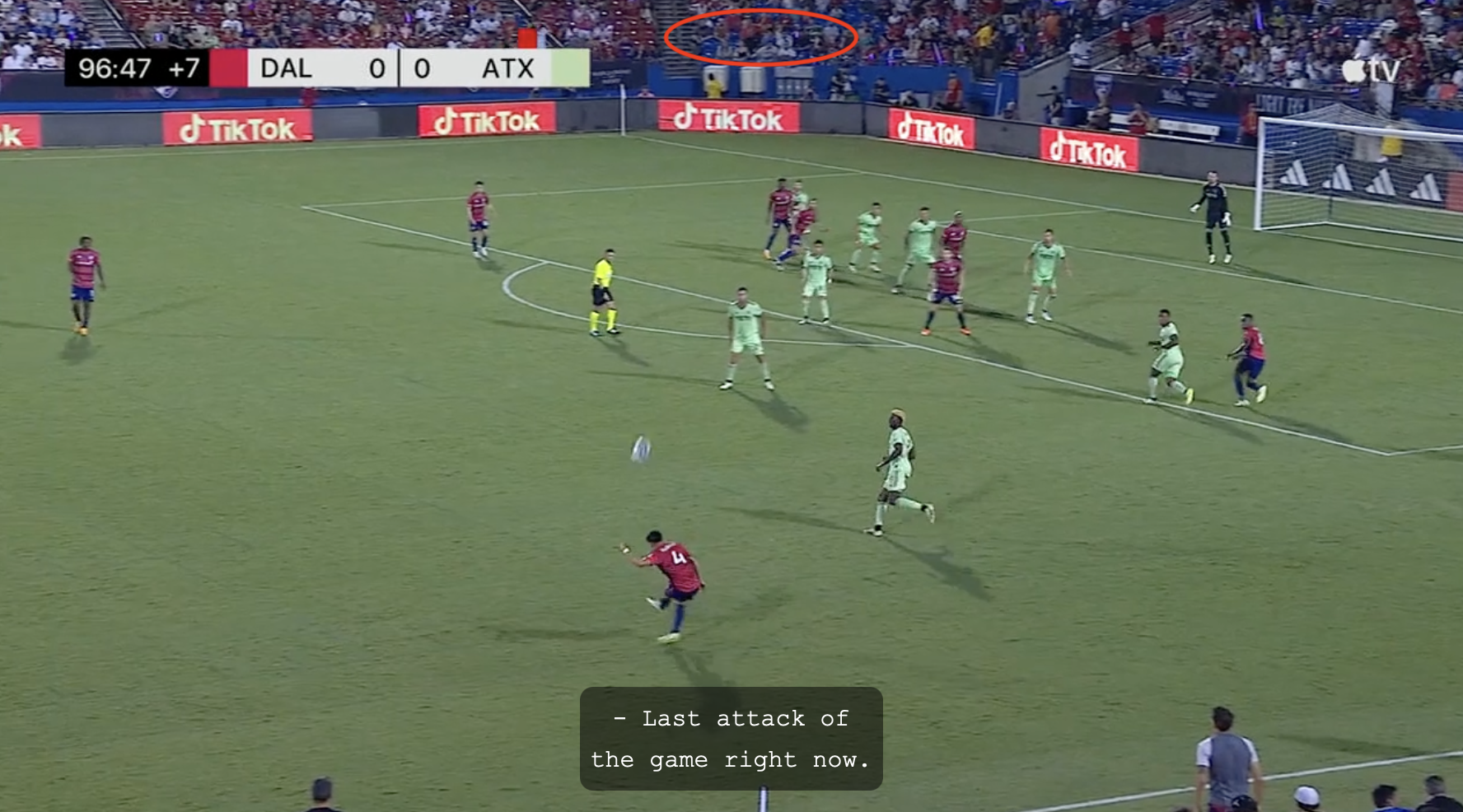
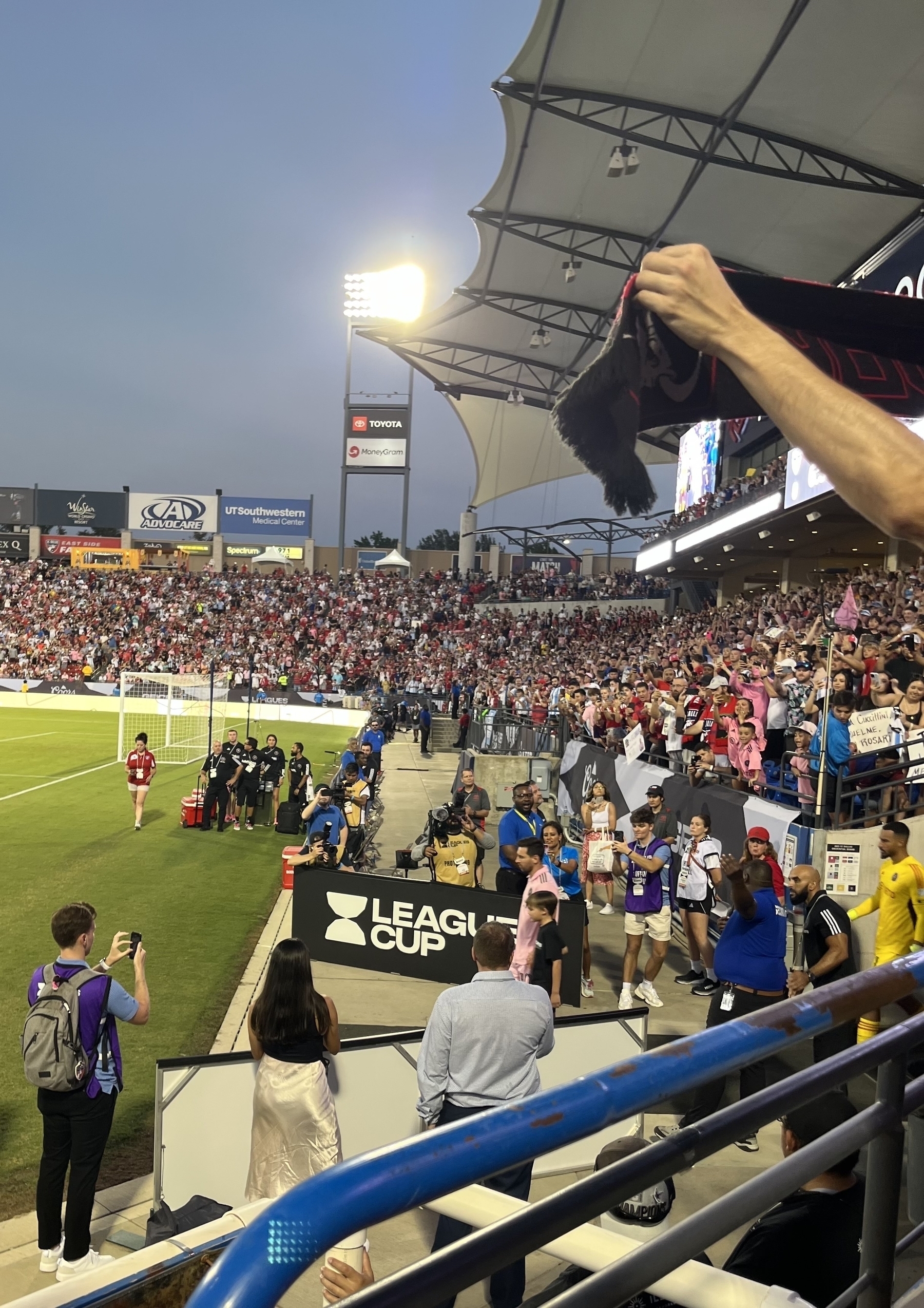
When it was 4-3 Dallas in the 84’ and Messi had a free kick on his left foot from outside the box, 20,000 people all knew what was going to happen. And it did.
Tough loss, but soccer and FCD both showed really well.
We encountered a Starlink Streak on a walk last night. I assumed it was Starlink, but enjoyed not knowing for certain for a moment.
I am entering my 14th year serving in some capacity in our school. Last year was my first not to teach any classes. It nearly drove me mad; D.V. that won’t happen again! I am looking forward to returning to the classroom this year to teach Latin to fifth graders and Theology to seniors.
If FC Dallas beats Nexaca on Tuesday and Nexaca beats Charlotte on Saturday and Atlanta beats Miami on Tuesday and Atlanta beats Cruz Azul on Saturday, then I might have a shot at having a shot at buying tickets to see Messi in Frisco, TX in the coming weeks.
So you’re saying there’s a chance! ⚽️
After not attending a soccer match since April, I will now be attending three in the next week: two FC Dallas League Cup matches, and a Barcelona vs Real Madrid friendly being played at AT&T Stadium.
This has inspired me to start a soccer diary that serves as a log of the matches I watch. ⚽️
Juniors at Coram Deo Academy research, write, defend, and present a rather impressive Capstone paper. The remarks below were shared the evening that our Dallas Campus Junior shared their capstones with our community.
I am encouraged by many things this evening, but I would like to name two of them.
First, I am encouraged to know that this is a place where students are trained to think deeply, slowly, and theologically about things that matter a great deal.
I have updated my Writing page to include quick links to a number of my recent written works, including a few Letters from the Headmaster that I have shared with our learning community over the years.